Showing posts with label Reactive Dog. Show all posts

04 December 2015

Earning His Novice Trick Dog Title

Mr. N waiting for his certificate paperwork to be filled out
Mr. N earned his Novice Trick Dog title recently! I blogged about it previously as a good option for reactive dogs to earn titles.

A flyball team was sponsoring a trick dog tournament as a fundraiser where they set up props and had a certified trick instructor supervising and witnessing. It took place in a warehouse so I thought the dogs would have a lot of space but that wasn't the case. Mr. N had to do his tricks with  strange dogs five feet away from him on three sides and he was super distracted. He managed to pull it together long enough to earn his first trick dog title by doing tricks like high five, pray and play dead.

The dogs have to earn a certain amount of points for each title with advanced tricks counting for more points. For the lower titles, you just need a witness to sign off (there's rumors that this is changing) but for the champion title, you need to send in a video. So you can do them all at home normally.

The novice tricks were not challenging for Mr. N but I was proud that he was able to do them in an extremely distracting environment for him. As a recovering reactive dog, he finds working around other dogs difficult. There was a time when he couldn't have done it. Good boy!

29 October 2015

Dog Sports for Reactive Dogs

Having a reactive dog means a lot of the traditional dog world and dog events are shut to you if your dog has trouble controlling themselves around other dogs. And reactive dogs are very often the dogs who need a job. High energy. Sharp. Busy brain.

These days with advances in technology and dog training, there are a lot more options for competing and titling with a reactive dog. Now you can send in a video of your dog performing and your dog can earn titles in a variety of different sports. This is also a great option for people who live far away from dog sport venues. 


Agility: The Virtual Agility League "provides a non-traditional, skills-based agility venue that allows people to submit dog agility performances for review by video. To give reactive or distracted dogs an equal chance to show off their agility skills, and recognition for the people who love and patiently work with them."

Disc Dog: If your dog is a frisbee pro, Pamela Johnson offers disc dog titles by video. She also offers canine freestyle routine and trick titles

Musical Freestyle: Dogs and humans show off a dance routine choreographed to music. "Rally Freestyle Elements offers video entries in Musical Freestyle for those that either live too far from live events or for those dogs not suited to the show environment."


Nosework: Nosework is traditionally recommended for reactive dogs, both as a way to build confidence and because the sport is set up to accommodate reactive dogs and their needs. This sport is also good for dogs with various disabilities. 


Parkour: In Dog Parkour, dogs use skills from human parkour and dog agility to overcome obstacles. "Dog Parkour helps with confidence and overcoming fears, and it is a low impact but challenging activity for any canine athlete."

Rally - FrEe This sports combines cues from Musical Freestyle and the competition format of Rally-Obedience. "It emphasizes the precise execution of fundamental freestyle and obedience skills while encouraging creative and novel behaviors on a Rally-Obedience style course." 

Trick Dog: Shake. Roll over. Sit pretty. Fetch! Do More With Your Dog! offers trick dog titles from novice to champion.
Photo by Grace W.

05 October 2015

How to Train Your Leash Reactive Dog with the LAT method

Mr. N walks nicely on a leash, 99.9 percent of the time. Children can walk him and they have under supervision and in quiet areas. That 0.1 percent is what gets him in trouble. Mr. N is what is known as a "frustrated greeter." He gets super excited to see other dogs and he will pull and bark and lunge on leash.

He is a lot better than he used to be. The very sight of a dog would send him into a barking, lunging frenzy. Now, he can walk and ignore other dogs across the street. We're still working on passing dogs on the same sidewalk. He can sometimes walk past very calm dogs who are lying down and not looking at him.

Mr. N ignoring the dog behind the fence who is barking at him. He says it's very hard.
We've been making this progress mostly with the LAT (Look at That) method from Leslie McDevitt's book, Control Unleashed. The premise is pretty simple. When your dog looks at a trigger (dogs, scary strangers, bikes, squirrels, skateboards etc), you reward them for looking at the trigger. It sounds counter-intuitive but it works! They learn to neutralize the trigger and focus back on you. Eventually, the dog will look at the trigger then automatically look back at you. This works both for dogs who are over-excited like Mr. N and dogs who are anxious or fearful.

You should start by practicing the cue with neutral objects that your dog won't react to then gradually add in lower-level distractions then work your way up to higher-level ones. For the neutral object, you could use a bottle or other household item and point at it and when your dog looks at the bottle, use a marker word like "yes" or click with a clicker and reward.

Mr. N knows he did a good job by looking at the other dog and not reacting. He thinks he deserves his treat now.
For the reward, you must use something the dog finds immensely rewarding. Reactivity work is very difficult for the dog and the reward must match. No kibble or dry treats! Unless your dog is willing to jump off a cliff for those. Mr. N is picky about his rewards so I can pretty much only use meaty treats and cheese. Right now, we're using Look Who's Happy treats that we were sent to review because Mr. N deems them worthy, they take a second or two to chew (less time to think about barking), and they're healthy and made with good ingredients so if he sometimes gets a ton of treats for not barking, so be it.

Look Who's Happy provided us with three bags of treats. Tenacious Little Terrier was not compensated for this review post. All opinions expressed are our own.
It's important to make sure your dog is not past threshold (calm and not over-aroused) when you do this. It has to be at a distance your dog can handle. So if you have to start at a football field's distance, that's what you do. Other things will affect your dog's threshold. With Mr. N and dogs, the following can impact his threshold: motion, speed, multiple dogs at once, dogs paired with a skateboard/bike, dogs giving him a hard stare, off-leash dogs, the other dog barking.

Mr. N practicing LAT by the dog park
Trigger stacking is also important to keep in mind. Multiple triggers will affect your dog's ability to keep it together. I always think of it as akin to dieting. If you're presented with multiple temptations throughout the day, (doughnuts at breakfast, co-worker's birthday cake at work, lunch invitation and offers of pizza for dinner) it's a lot easier to give in. You only have so much impulse control. You may be good all day and then something sends you over the edge and you gorge on ice cream. Same goes for your dog. They may ignore the first five dogs and then after the sixth one will turn into a screaming maniac.

Mr. N has conquered bikes and joggers and squirrels and cats for the most part using this method. We're continuing to work on his hardest challenge, dogs. He tries very hard and sometimes he backslides but we're getting there.

No dogs were barked at during the making of this post.

It is very difficult to capture a squirrel and dog in the same frame.
Welcome to First Monday's Positive Pet Training Blog Hop hosted by Cascadian NomadsTenacious Little Terrier and Rubicon Days. Please share your responsible pet owner positive pet training tips by linking a blog post or leaving a comment below. Any positive reinforcement training posts or comments are also always welcome. The Positive Pet Training Blog Hop goes all week long. Our next hop will begin Monday, Nov. 2nd with a training and exercise theme and continues for a week. 

05 March 2015

Great Places to Walk Your Reactive Dog

There are days when you meet dogs around every corner and off-leash dogs come barreling at your reactive dog and your dog is just freaking out. Sometimes your dog(s) just need a break so their Cortisol levels can settle or you're trying to train where your dog won't be overstimulated and it just isn't possible in your neighborhood.

There's the option of walking super late at night or early in the morning. However, Mr. N and I are not morning people/dogs. And I don't always feel comfortable taking Mr. N out by myself at night. So I've found some good places to walk a reactive dog during the day without running into potential triggers.

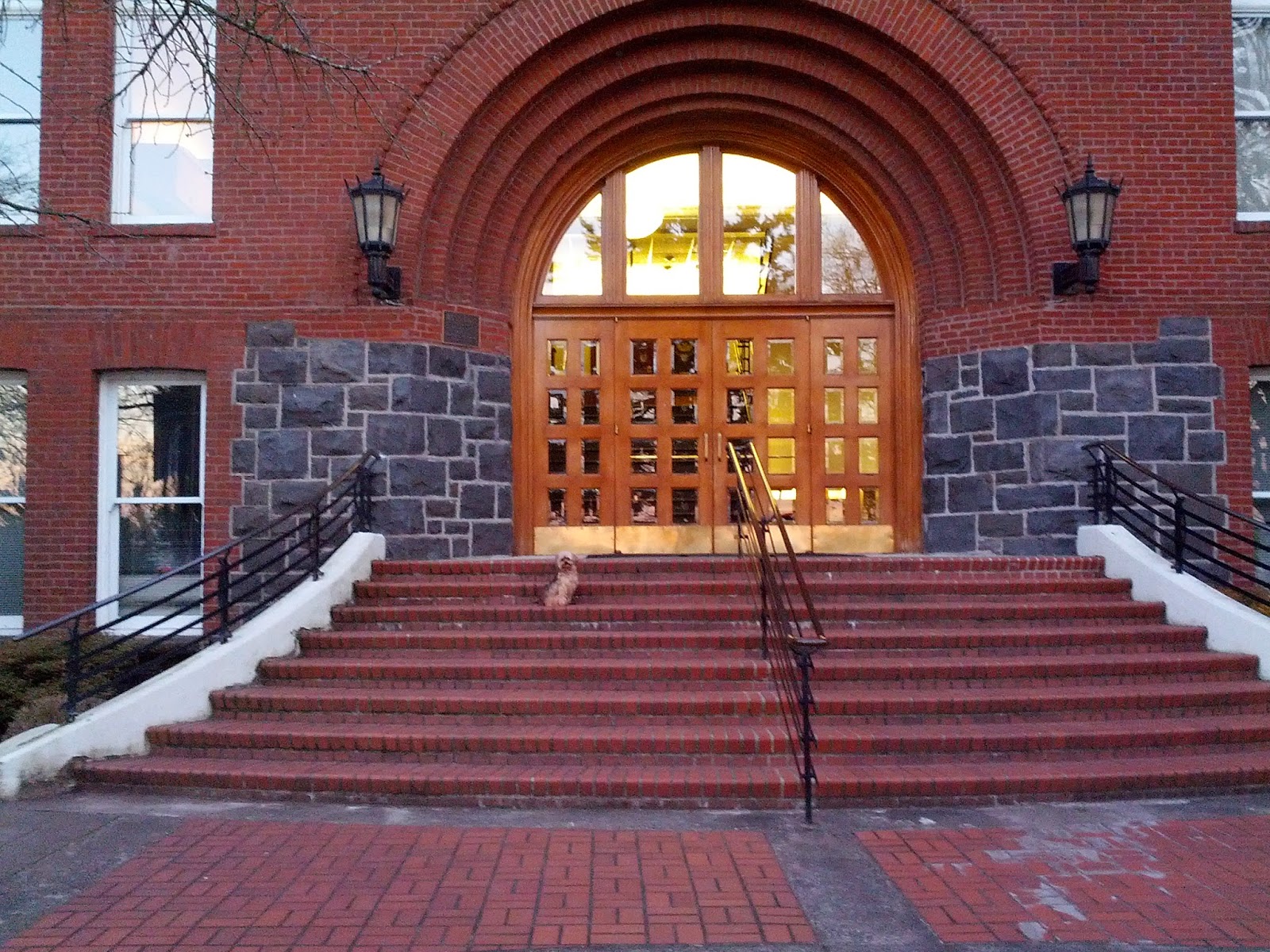
On days when I really don't feel like dealing with off-leash dogs (and their owners), I take Mr. N to a nearby university. They usually have a fair amount of maintenance and security people wandering around and I think the campus' leash law is enforced. I think I've only seen an off-leash dog there once. There are also very few dogs there to begin with. The majority of our visits, we haven't seen any. Obviously, this is not ideal for dogs who are reactive to people.

Can you spot Mr. N?

Industrial areas are also usually dog-free. It is not a very scenic walk but other dogs are scarce, not to mention the people. You just have to keep an eye out for heavier traffic and especially trucks. Sometimes those areas lack sidewalks. I haven't found that to be a huge problem here though.

Also the area around our airport rarely has dogs and not that many people.  In Portland, the airport area is mostly industrial with a few airport hotels. If your dog is not sensitive to loud noises, this is a great place for avoiding other dogs and people.

What places do you go to walk your reactive dog(s) or if you just want a little peace and quiet?

Mr. N watching the ROTC practice

My Five Favorite Positive Training Tools for Dogs

Tools are an essential part of life and dog training especially when your dog has figured out how to use items as tools. These are some of m...